IN STEP WITH THE WORLD
From HÅNDVÆRK bookazine no. 15
buy your copy here
I meet Pil Bredahl at the main office of I TRÅD MED VERDEN in Copenhagen’s North-West district. I explain the theme of this issue of the bookazine, TRANSFORMATION:
At first, I went for the concept of circularity. After working on that for a while, I found it to be too narrow for my focus, which was to talk to people who have chosen to dedicate their working lives to changing our view of nature and consumption – in particular our consumption of virgin resources.
Pil replies,
‘That’s interesting. I see circularity as the general law – the law of ecology – as we mimic the way nature functions: an existing system in which anything that is created – including anything we create – has an intrinsic life that is transformed and becomes something else.’
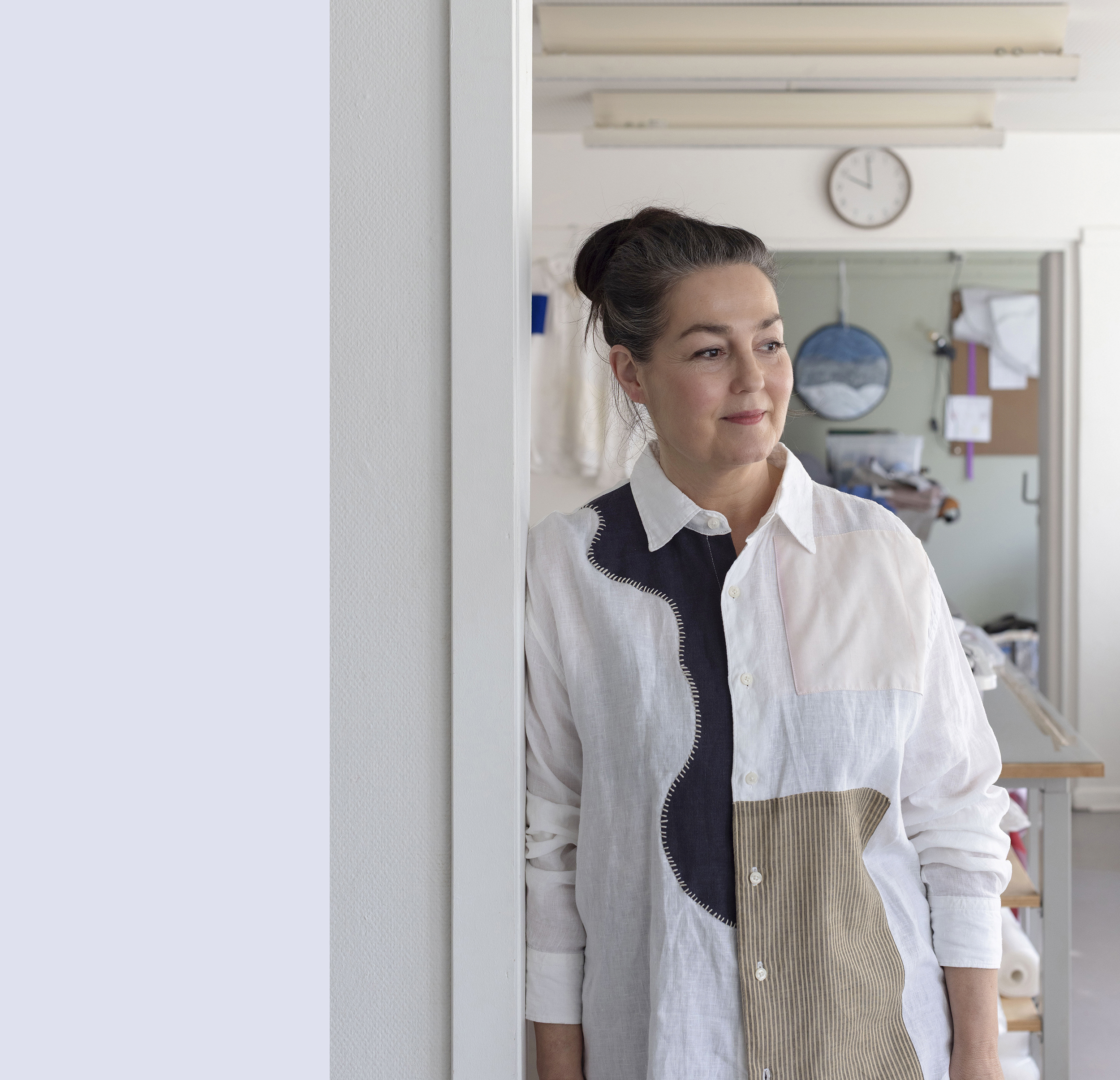
Pil Bredahl (b.1971)
1998 product and furniture designer from the Danish Design School (now the Royal Danish Academy)
2013 MA in Design from the Royal Danish Academy
Since 2005, Pil Bredahl has worked as an independent designer, been a creative product manager for the company now called Audo and served as judge in the TV programme Danmarks næste klassiker (Denmark’s Next Classic). She has held – and continues to hold – many key positions in the industry, including as head of the Danish Arts Foundation’s Grant Committee for Crafts and Design and as chair of the board for the company I TRÅD MED VERDEN (Threaded with the World).
In 2007, she and her colleagues Henriette Melchiorsen and Liselotte Risell cofounded the design group FairTrade Designers. Its mission is to help local craft makers and artisans in struggling regions, including Africa and Asia, to create a sustainable basis for selling their products in the West. Most recently, FairTrade Designers carried out a project in Bethlehem, Palestine.
In 2025, she curated the Mindcraft exhibition in Copenhagen.
I TRÅD MED VERDEN
A socioeconomic enterprise that operates textile workshops in non-profit housing estates in close cooperation with housing associations and municipalities. The workshops offer jobs on a range of different terms, including occasional work, flexible hours, full-time jobs and part-time jobs.
I Tråd Med Verden has workshops in Copenhagen NW, Taastrup, Farum and Aarhus.
Liv Bejer Heckmann, who is the head of design and development, explains that for them, design is both about opportunities and community and about products – products that are generally made from discarded fabrics.
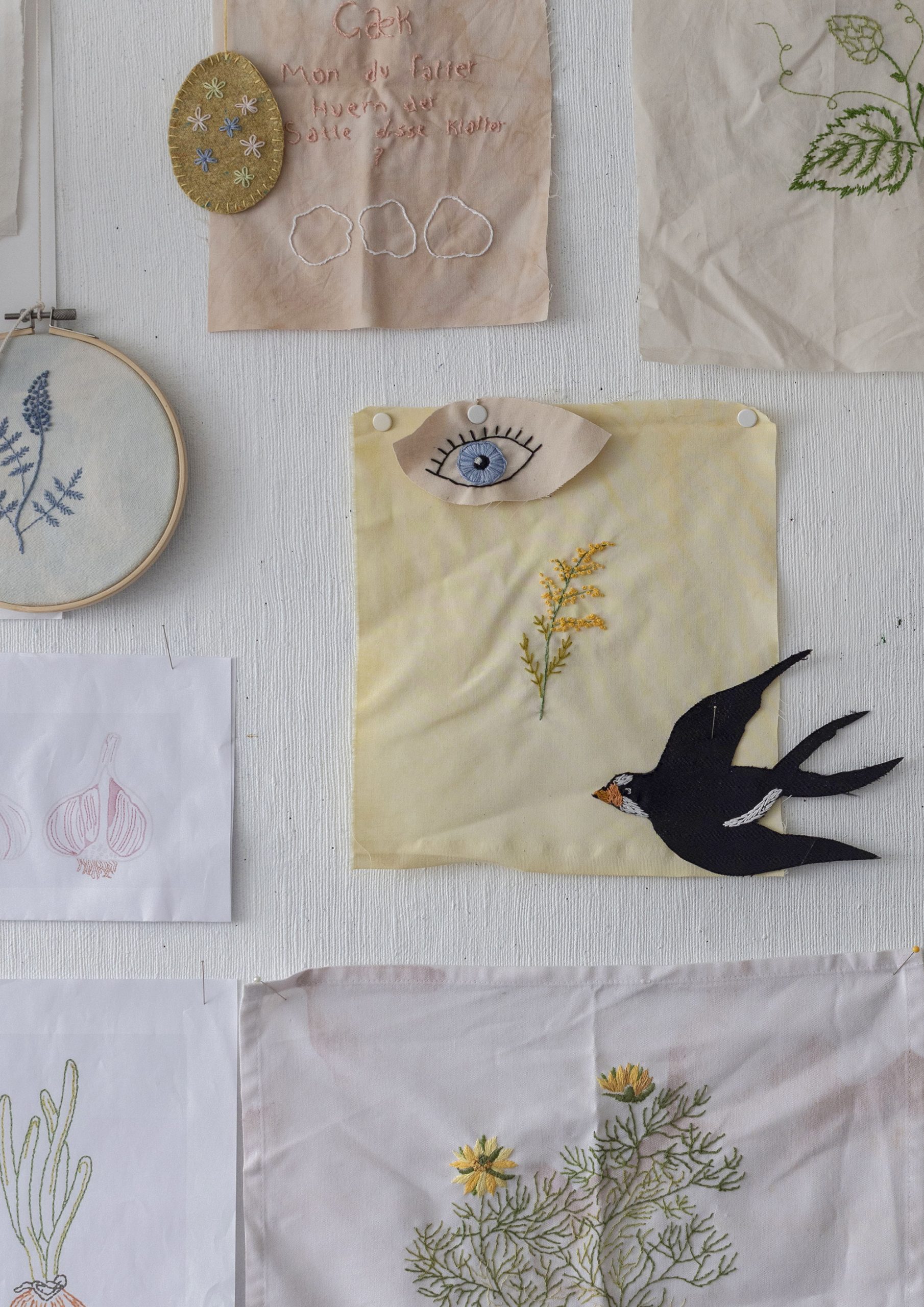
I Tråd Med Verden has a collection designed by one of the 12 affiliated designers, who also develop bespoke solutions for external partners. For example, the enterprise recently completed a large order for Copenhagen City Hall for workwear made from used tablecloths. The Copenhagen location also has a repair service, where private customers can hand in items in need of mending. Companies may also choose to offer mending as a workplace perk and have a seamstress come to the workplace with a sewing machine. Finally, it has an embroidery workshop where calm and immersion are both a means and an end.
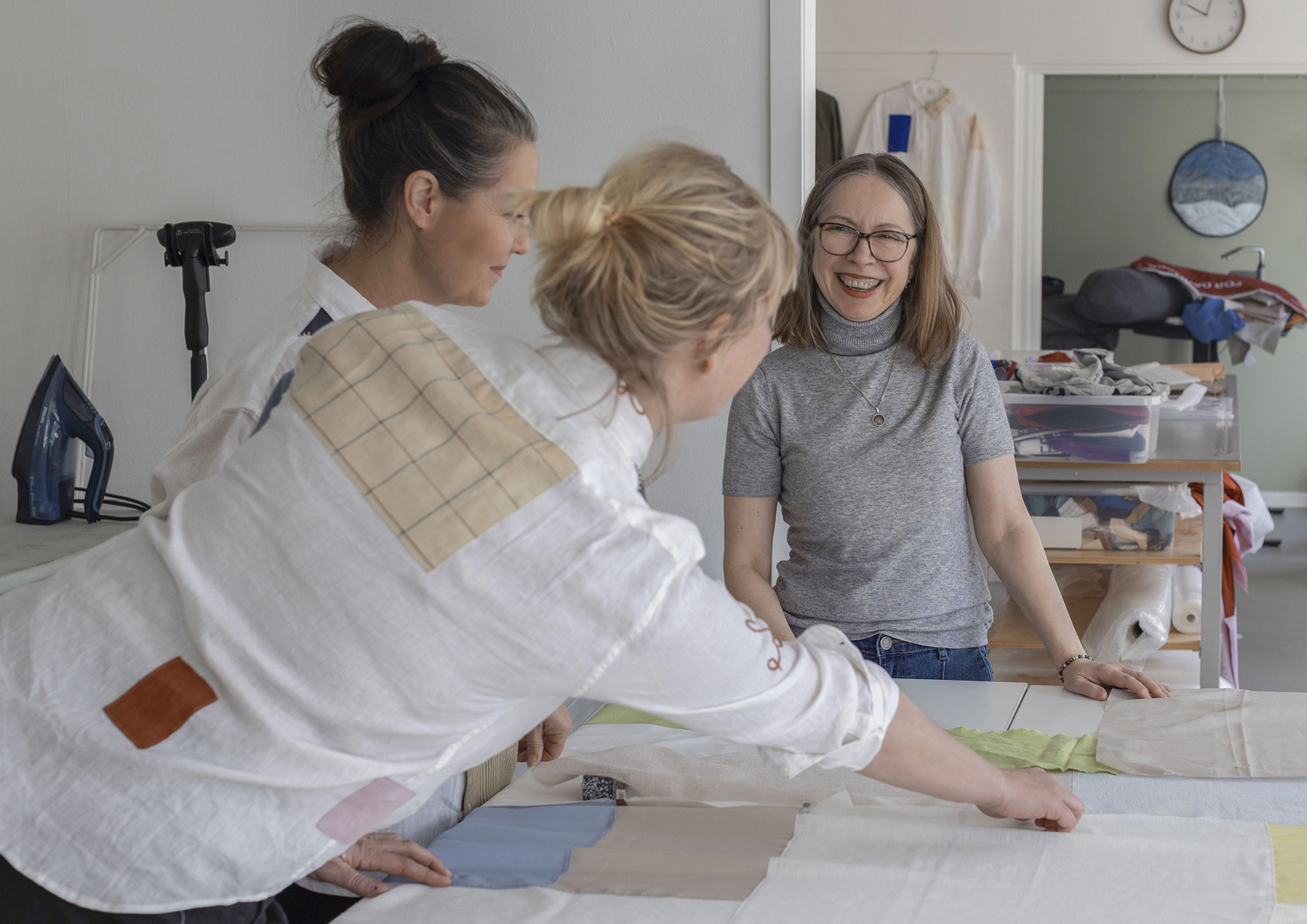
In the photo, Pil and Liv are wearing linen shirts donated to I Tråd Med Verden from a large commercial fashion company because they were stained. Instead of being scrapped, the shirts have now been upcycled with appliqués and are sold through the web shop.
The topic of our talk is transformation in the design industry – Pil’s home ground. On the Design Council’s website, she is quoted as saying,
‘To me, design is a dialogue-based profession that comes up with concrete answers to issues that affect people’s lives. Design solutions usually involve consumption, and our climate footprint is mainly related to the structure of consumption. This means that one of the keys to a more sustainable civilization can be found in the ability of designers to grasp both the concept of circularity and the significance of social responsibility. I see design as a metaphor for a certain attitude, because the work of designers actually shapes our physical world. In my view, good design is something that creates a positive resonance in other people.’
Elsewhere, she has said,
‘Good design is not just about form following function. Form and function are equal. When function also follows form, the design becomes more durable.’
‘It’s funny that you dug up that quote,’ she says. ‘I guess what I’m trying to say is that for a long time, we’ve had this idea of good design as something in which form follows function – a classic modernist approach to problem-solving. But if we are to develop an attachment to a given design – which we must, because future products have to last a long time – beauty, sensuous qualities and emotional appeal are just as important as what we perceive as function. This is something that craft makers and artists excel at bringing to the table.’
Since the postwar years, consumption in our privileged part of the world has increased. Regardless of spending power, we identify with our consumption, and products – including design products – are made available across the full range of price points.
Few consumers draw the distinction between what is good and what is merely adequate. Because many have never experienced things with depth of materiality and quality, they’re unable to recognize it when they encounter it.
‘We have been so focused on growth. And I understand why,’ says Pil. ‘It was convenient, and it’s difficult to roll back, even for me. Although my consumption isn’t huge, I do live in a house that needs heating. Many of us might have given up air travel, but our use of AI now has a bigger environmental impact than the airline industry.’
‘In a world where energy is 100% green, AI, heating or our level of consumption overall wouldn’t be a problem in itself – provided we didn’t use virgin materials but used the resources that are already in circulation. But in the real world, energy comes at a cost, and we need to prioritize. We have to distinguish more clearly between “need to produce” and “nice to produce”,’ she says.
We talk about the need to distinguish between the use of circular and virgin materials. In the healthcare sector, for example, we have to accept the latter, but that is far from necessary in fashion or interior products. Tinfoil is not a vital necessity, and new clothes or new furniture are not a human right.
‘Historically, design has been about improving life for people, and design has a potential for renewed relevance by addressing the challenges we face in the transition to a more sustainable society. As before, the designer’s role is to make improvements, but the planetary limits are the most important part of the equation,’ says Pil. ‘Importantly, this requires a collaborative approach, and designers are trained to work with engineers and manufacturers as well as marketing and sales.’
In the latest season of Danmarks næste klassiker, I heard you and Kasper Salto discuss how, in the name of sustainability, we need to get used to using wood with knots in it. Does sustainability have its own particular aesthetic?
‘Yes and no,’ Pil replies after a moment’s pause. ‘We are going to look at surfaces in a different way. We can’t insist on only using the knot-free parts of a tree. If we fell it, we have to use every last splinter of it, and that mindset has to be implemented from the design phase. Furniture – and other products – should be made so they can be dismantled when we don’t want to use them anymore. We should stop lacquering every surface, because lacquer is toxic, and instead plan for patination as part of the expression.’
That is easy to do when you work with natural materials, I say, dreaming of a beautifully patinated natural leather sofa that only increases in value as it gets older and of gorgeous wooden tables with the marks of many, many meals.
‘Above all, we have to base the transition on facts,’ says Pil, disrupting my train of thought. ‘Someone who uses Botox and has long acrylic nails but lives in a small home and takes the bus may well have a smaller climate footprint than someone who wears wool and drives a car.’
She adds that the changes that are needed will require equal parts legislation and inclination, driven by desire and knowledge. ‘Fortunately, there is a lot of new legislation in the pipeline. Eventually, the transition to more sensible consumption patterns will go the way of the ban on smoking in public places – we’ll see a change of attitude, also influenced by ethical concerns.’
She illustrates her point with an example:
‘When we founded FairTrade Designers, in 2007, one of our focus points was labour conditions.
If you see a hand-embroidered shawl for sale for DKK 150, you just know it wasn’t produced under nice conditions, and hopefully, you will find that repulsive.
It’s a question of knowledge, sensuous qualities, emotions and empathy.
Unfortunately, there are still people, designers as well as consumers, who close their eyes – drinking champagne and dancing on the deck of the sinking ship …
That is one of the reasons why the transition process is too slow. We have exceeded the limit of what nature can sustain, and clearly, habits are difficult to change, particularly for people over 35.’
And younger people?
‘When I look at the new design graduates, I feel optimistic. They were born into the agenda that the rest of us are struggling to adopt. They seem to have a basic and intuitive understanding of the materials they use. They like to get hands-on in their work, and they’re less focused on owning things. They also don’t necessarily think that big is beautiful or attractive, and many of them are more interested in receiving Bumblebee awards (for sustainable design) than Gazelle awards (for rapid growth).’
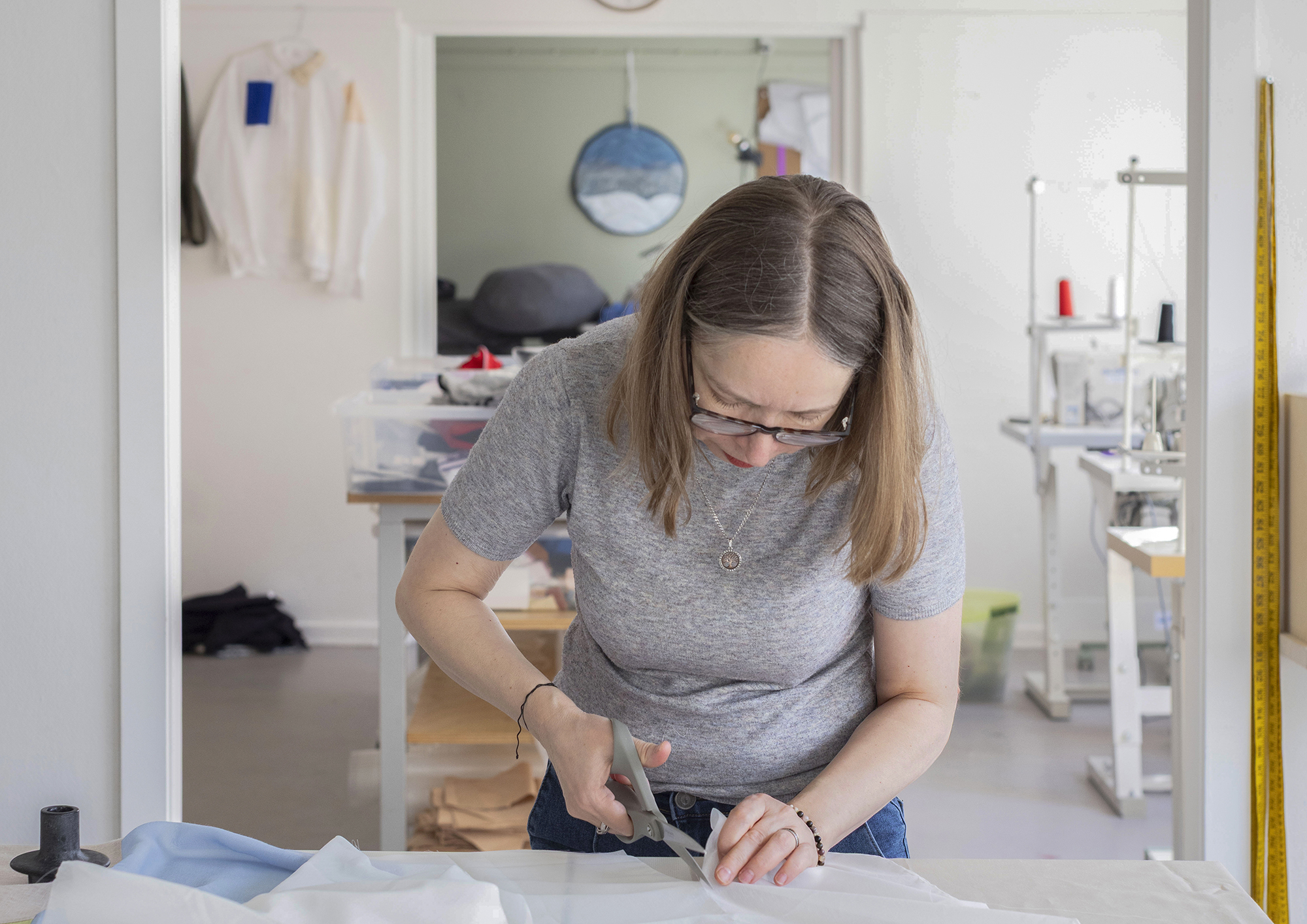
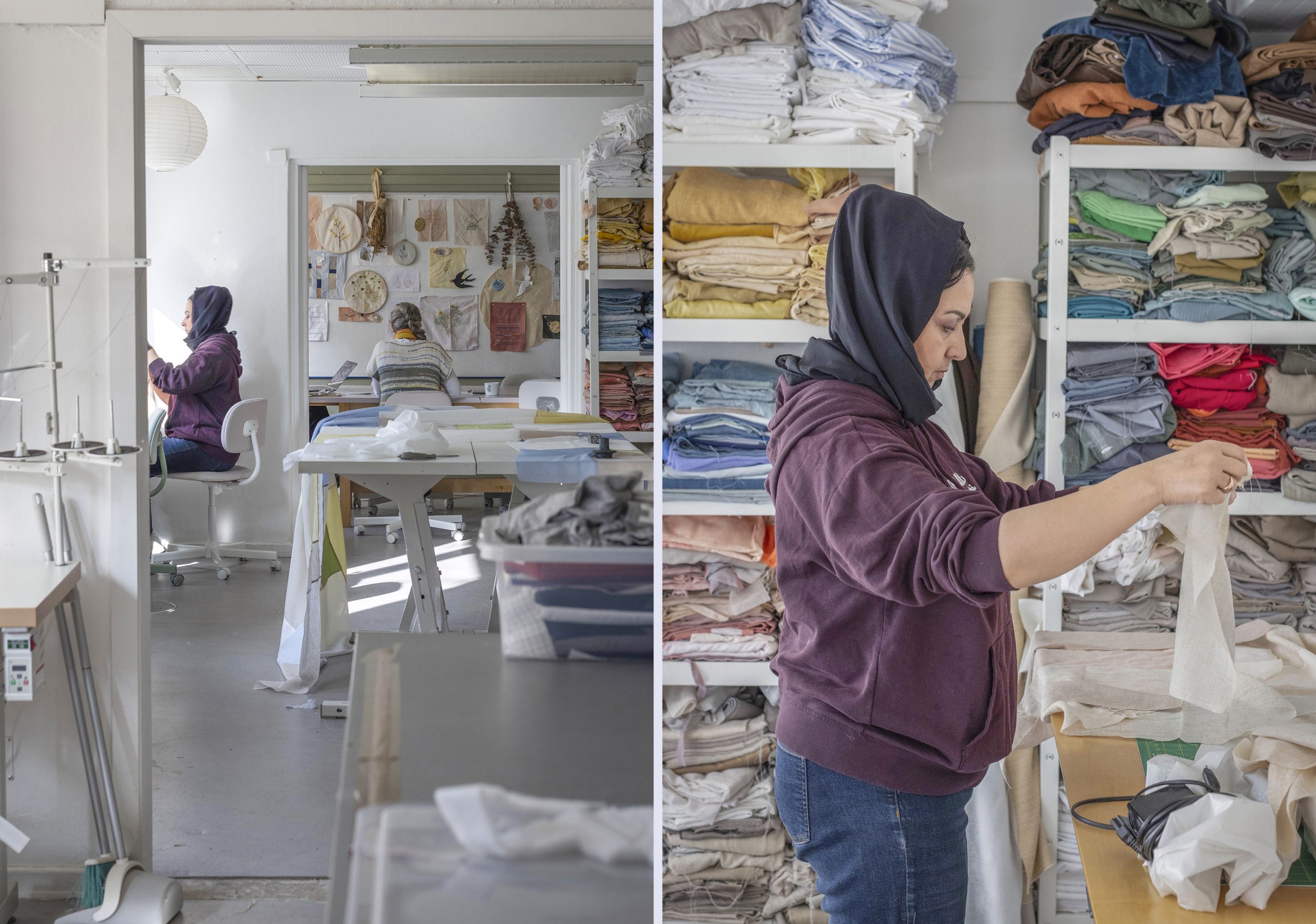
On this positive note, I turn my attention to the workshop, which is a ray of sunshine itself. Here, the day’s work is just getting started. One of the tasks today is sewing curtains, with Olena Khrystynchenko in charge. She is a refugee from Ukraine, where she trained as a theatre costumier. For the past 3½ years, she has been an employee of I Tråd Med Verden.
Skrædderkunst – på dansk
Mott Skrædderi i Århusgade har længe stået på min ”må jeg snart besøge liste” – helt præcist siden skræddermester Karina Mott hjalp mig med en portion stofmasker til 3daysofdesign udstillingen i 2020 DAHLMAN x HÅNDVÆRK bookazine i 2020.
Karina Mott er herreskrædder, men syr til alle køn, med afsæt i den klassiske herregarderobe, jakker, bukser, skjorter og frakker, desuden nederdele.
Hun overtog i 2011 et traditionelt herreskrædderi i Århusgade i København og har gennem årene løsnet på de skrevne og uskrevne regler for materialevalg og snit både i forholdet til køn og anvendelsesområder.
”Da jeg startede her, var den typiske kunde en moden mand, som købte sine formelle jakkesæt som arbejdstøj”, fortæller Karina over en op kaffe i det lille lokale hvor hun altid har første møde med sine kunder.
”Jeg interesserede mig allerede den gang, ikke bare for skrædderkunst, som i sig selv er tøj skabt til lang levetid, men også for det bæredygtige aspekt i valg af metervarer, hvis baggrund jeg kender og tager stilling til ud fra et bæredygtighedssynspunkt.
Den gang fik herrerne flakkende blikke, når jeg insisterede på at dele min viden.
Nu har jeg en broget kundeskare, af mænd og kvinder, herunder mange som opsøger mig, ikke mindst på grund af det bæredygtige aspekt”.
En bestilling
Lad mig vide hvordan det foregår hvis jeg vil have syet, for eksempel et jakkesæt, hos dig?
”Først tager vi et indledende møde, det foregår her hvor vi sidder”.
Vi befinder os i lille lokale bag skrædderiet, møbleret med lave stole, sofabord, der er kaffe i guldkopperne og udsigt til prøverum med spejl og stakkevis af stofprøver.
”Ved det møde sporer jeg mig ind på dine ønsker og behov.
Der er naturligvis stor forskel på om det er første gang du besøger mit skrædderi, om det er første gang på et skrædderi overhovedet eller, om du gennem mange besøg er blevet ”uddannet” i at forstå din krop, din stil, og hvad du kan forvente af skrædderen.
På det første møde lægges snittet fast, jeg tager mål og vi vælger stof.
Dernæst konstruerer jeg et mønster fra grunden”.
Da jeg ankom, var Karina i gang med et sådant mønster. Når hun har konstrueret og klippet mønsteret ud, tegnes mønsterdelene op på metervaren med kridt, det er vigtigt at alle mønsterdele placeres således at terner og striber møder hinanden præcist i overskæringer og indsnit.
”Delene klippes ud, med rigeligt sømrum og sys sammen, de lange sømme sys på maskine, alt andet, cirka 80% håndsys.
På anden prøvedag justeres så balance og pasform er perfekt. Der markeres til lommeplacering.
Inden anden prøvning sys beklædningsgenstandene så godt som færdigt.
Ved anden prøvning justeres de sidste detaljer, herefter og gøres sættet helt færdigt inden vi træffes fjerde gang, hvor jeg afleverer opgaven”.
Djævlen sidder i detaljen
”En af de store forskelle på et stykke skræddersyet tøj, i særdeleshed på en skræddersyet jakke eller frakke, og et stykke ”ready to wear” eller ”made to measure” ligger i det håndsyede, herunder i at ingen indlægsstoffer hos skrædderen er limet fast til yderstoffet, men fæstnet i hånden.
Lim slipper langsomt under påvirkning af varme og fugt”, forklarer Karina, ”og limede indlægsmaterialer er ufleksible. Skrædderens indlægsmaterialer er fremstillet af naturmaterialer og arbejder sammen med ydermaterialet.
En anden er naturligvis, at tøjet ikke bare er tilpasset den individuelle krop, men skabt med udgangspunkt i kroppen”.
Uddannelse
Karina brænder for sit fag og for at formidle sin viden.
Af samme årsag afholder hun løbende kurser for private som vil lære at konstruere og sy, og hun afslutter i dagene omkring mit besøg et mester-/elevforhold til en ung mand, som 1. maj kan kalde sig herreskrædder.
”Der er, til trods for at skrædderne oplever øget efterspørgsel ikke længere en skrædderskole i Danmark”, fortæller Karina, ”man kan blive beklædningshåndværker, det er en bred uddannelse målrettet industrien. Man kan i praktikperioden søge en skrædderspecialisering.
Bare er det er vanskeligt, fordi det reelt er en omkostning for en mester at have en elev, som kommer fra et skoleforløb, som ikke er målrettet faget.
Selv skal jeg ikke have en ny elev foreløbig, selvom jeg godt kunne bruge flere hænder, ordrebogen er fuld”.
Djævlen sidder i detaljen
”En af de store forskelle på et stykke skræddersyet tøj, i særdeleshed på en skræddersyet jakke eller frakke, og et stykke ”ready to wear” eller ”made to measure” ligger i det håndsyede, herunder i at ingen indlægsstoffer hos skrædderen er limet fast til yderstoffet, men fæstnet i hånden.
Lim slipper langsomt under påvirkning af varme og fugt”, forklarer Karina, ”og limede indlægsmaterialer er ufleksible. Skrædderens indlægsmaterialer er fremstillet af naturmaterialer og arbejder sammen med ydermaterialet.
En anden er naturligvis, at tøjet ikke bare er tilpasset den individuelle krop, men skabt med udgangspunkt i kroppen”.
Uddannelse
Karina brænder for sit fag og for at formidle sin viden.
Af samme årsag afholder hun løbende kurser for private som vil lære at konstruere og sy, og hun afslutter i dagene omkring mit besøg et mester-/elevforhold til en ung mand, som 1. maj kan kalde sig herreskrædder.
”Der er, til trods for at skrædderne oplever øget efterspørgsel ikke længere en skrædderskole i Danmark”, fortæller Karina, ”man kan blive beklædningshåndværker, det er en bred uddannelse målrettet industrien. Man kan i praktikperioden søge en skrædderspecialisering.
Bare er det er vanskeligt, fordi det reelt er en omkostning for en mester at have en elev, som kommer fra et skoleforløb, som ikke er målrettet faget.
Selv skal jeg ikke have en ny elev foreløbig, selvom jeg godt kunne bruge flere hænder, ordrebogen er fuld”.
Related stories